Smart GrowtH, Real clients
We help startups and growth-stage companies get recommended by AI systems, capture high-intent demand, and convert it into predictable forecasted revenue.
01
AI Visibility
Get recommended by AI systems and position your brand where decisions are happening
02
Customer Acquisition
Own the moment buyers are ready to act and build system frameworks designed at scale
03
Revenue optimization
Free up time by optimizing and automating customer journeys to maximize long-term revenue
The ProblemYour data leaves signals. Amidst the churn of everyday operating rhythms, you’re missing out on valuable opportunities.
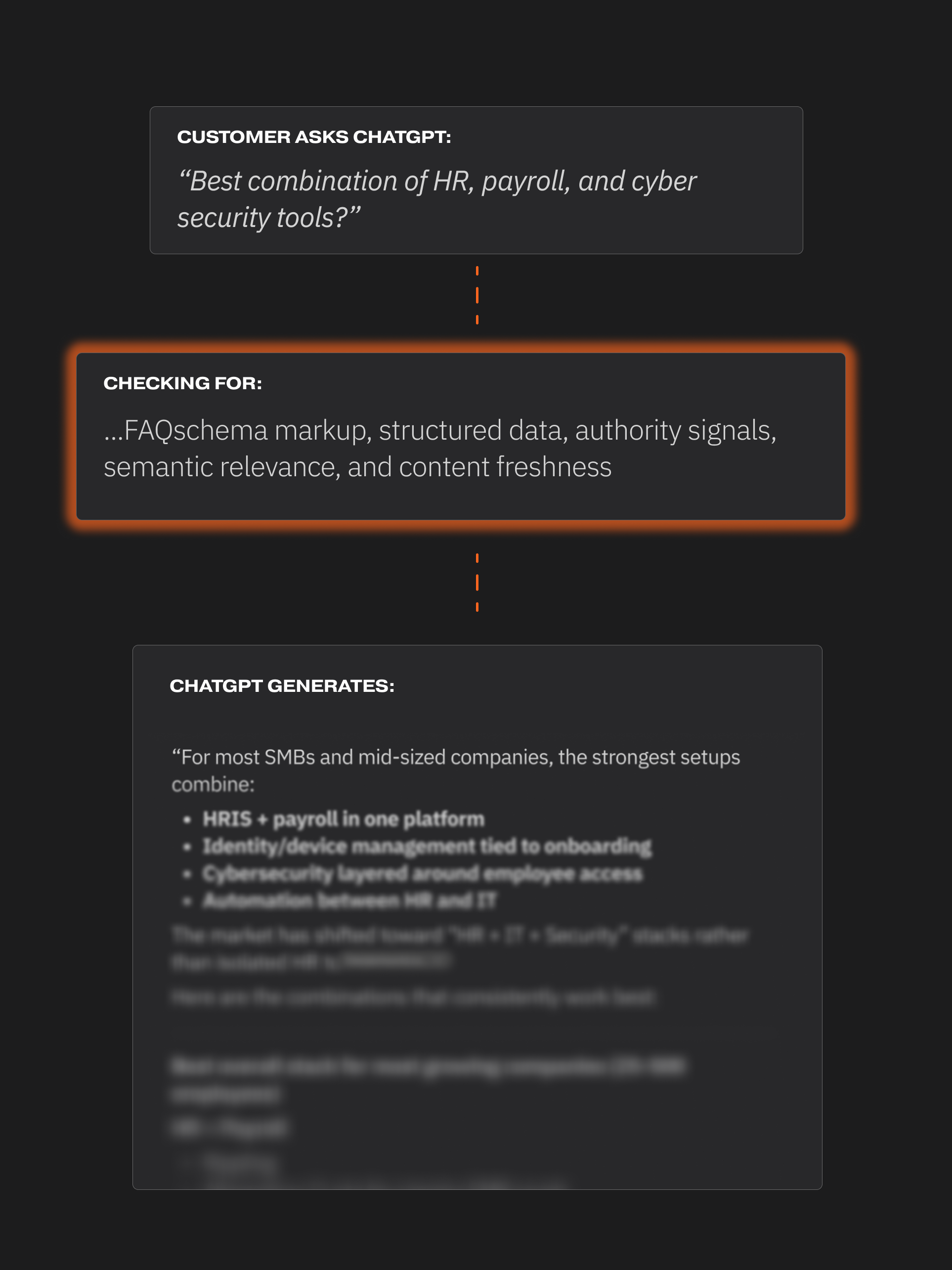
The Future of Search ·
The Future of Search ·
Analyze your AI Visibility
You get:
AI visibility score
Competitive comparison
Actionable improvement roadmap
Ongoing tracking
-
![Close-up of hands typing on a laptop keyboard, wearing a striped scarf.]()
Get Found
Show up where the right customers are already looking. We strengthen your search and AI visibility, business listings, website presence, referral channels, and content plan so your brand is easier to find, trust, and choose.
-
![Black and white photo of a woman walking a small dog, with shadows casting long shapes on the street, an open door or window with a ledge is visible at the top of the image.]()
Get Leads
Reach the right prospects with clearer messaging and a smarter outreach strategy. We refine your positioning, campaigns, buyer profiles, and qualification process so your team can attract better-fit leads and move more conversations toward real opportunities.
-
![Close-up black and white photo of a man wearing sunglasses, holding a phone to his ear, with only part of his face visible.]()
Get Selling
Help your team sell with more clarity and confidence. We build or refine your sales process, review your tools and materials, analyze customer data, sharpen buyer insights, and improve pitches and training so every conversation is more consistent, effective, and likely to convert.
-
![Two business professionals sitting on a bench in an airport, looking at a phone, with a plain wall and a window in the background.]()
Optimize
Improve performance by tightening the systems behind your sales and customer journey. We set up your CRM, refine your process, review team activity and materials, uncover where deals and customers are slipping away, and build clearer forecasts so you can plan smarter and grow with fewer leaks.
-
![Close-up of a geometric structure with linear, slatted design, predominantly black and white.]()
Modernize
Build a more efficient business with systems designed for what’s next. We map your processes, evaluate your tools and team structure, assess AI readiness, and uncover smart automation opportunities with clear ROI—so you can streamline operations and grow with less friction.






Our Services
We know every business problem is not a one-size-fits-all. Our services can be crafted and combined to fit your needs.
-
Market & Customer Analysis
ICPs & Buyer Personas
Customer Journey Mapping
Competitive Analysis & Sales Battlecards
Pricing Strategy
Offer Positioning & Launch Strategy
Go-To-Market Strategy & Sales Enablement
-
Social Media Strategy & Content Planning
SEO & Keyword Strategy
AI Search Optimization (AEO & LLM Optimization)
Technical SEO, Schema Markup & CMS Support
Website Branding, Messaging & Content Creation
Google Business Profile & Local Listings Optimization
Google Ads Management & GA4 Analytics Setup
Online Review & Reputation Management
-
Outbound Sales Strategy & Email Sequence Development
Sales Decks, Playbooks & One-Pagers
Lead Qualification & Sales Process Design
Sales Coaching & Team Development
Sales Call Intelligence & Conversation Analysis
-
CRM Setup, Cleanup & Optimization
Lead Scoring & Automated Lead Routing
Pipeline Health & CRM Hygiene Audits
Sales Forecasting & KPI Dashboard Setup
Revenue Tech Stack Consulting & Implementation
Business Systems Automation & Workflow Design
Customer Experience & Service Operations Design
Sales Intelligence & Enablement Platform Setup
AI Customer Service Agents & Chat Automation
Packages
Foundation
Audit, Analyze, and Build the Roadmap
Designed for businesses that need clarity before investing in execution. We assess your current marketing, sales, and operational systems to identify opportunities, gaps, and priorities.
Best for: Businesses seeking expert guidance, visibility into performance gaps, and a clear action plan.
-
Marketing, sales, and systems audits
Market and competitive analysis
SEO, AI Search, and website evaluations
CRM and pipeline assessments
Messaging, positioning, and buyer journey analysis
Process and workflow reviews
Strategic recommendations and reporting
Growth
Strategy + Implementation
For businesses ready to move beyond recommendations and begin implementing high-impact improvements across marketing, sales, operations, or customer experience.
Best for: Businesses looking for both strategic direction and hands-on execution support.
-
CRM setup, optimization, and workflow automation
SEO, content, and website improvements
Analytics and reporting setup
Sales enablement content, systems, and process design
Lead routing and qualification,
Outbound targeting and sequences
AI tools and operational automations
Funnel, conversion, and customer experience improvements
Scale
Ongoing Optimization + Growth Partnership
A continuous advisory and operational support engagement focused on refinement, optimization, and sustainable growth over time.
Best for: Businesses that want an embedded strategic partner focused on long-term growth and operational performance.
-
Continuous optimization and reporting
Content production and campaign support
Revenue and pipeline reviews
Sales call analysis and coaching
Ongoing SEO and AI search optimization
Automation maintenance and refinement
KPI reviews, forecasting and check-ins
Iterative testing and performance improvements
FAQ
GTM Strategy + Growth
-
Growth gets harder when the business outgrows its early operating model. What worked at $1M or $3M in revenue often starts to break as CAC rises, sales cycles get more complex, and teams become more specialized.
The usual pressure points are familiar: unclear positioning, uneven demand generation, weak sales and marketing alignment, poor pipeline hygiene, and immature revenue operations. When those issues stack up, growth becomes expensive, conversion rates soften, expansion slows, and the company loses efficiency even if top-line demand still exists.
-
A GTM strategy defines how a company reaches the right buyers, communicates their value proposition, generates demand, and converts opportunities into scalable revenue growth.
-
An ICP defines the type of companies most likely to buy, succeed, and deliver strong LTV. A buyer persona describes the people (by job title or responsibilities) inside that company involved in the buying decision.
That distinction matters. ICP fit helps you target the right accounts. Personas help you speak to the right problems, objections, and buying triggers. Without both, companies often generate activity that looks healthy on paper but produces weak pipeline quality.
-
Demand generation becomes more efficient when targeting, messaging, channel strategy, and pipeline measurement are working in concert. More spend does not override a weak data system.
High-efficiency demand generation depends on:
clear ICP segmentation and definition
stronger message to market fit
reliable attribution quality
close alignment between campaign intent and sales follow-up
optimization against qualified pipeline, not lead volume
If marketing is producing activity but sales is not seeing attributed revenue impact, the problem is targeted alignment, not effort or spend. Tying channel attribution to direct wins through data is the best way to understand what levers to pull for more pipeline.
AI Search + Market Visibility
-
AI search optimization improves how platforms like ChatGPT, Gemini, Claude, Perplexity, and Google AI Overviews understand and surface your company. The goal is to make your business easier to retrieve, verify, and recommend in answer-driven search experiences.
In practice, that often includes:
stronger entity clarity
retrieval-ready content
tighter topic coverage
cleaner digital trust signals
better alignment between your site, third-party mentions, and market positioning
-
SEO is built to improve visibility in traditional organic search results—i.e. showing up on the first page of browser results. AI search optimization or AEO (Answer Engine Optimization) is built to improve visibility inside generated answers.
You need both to maximize visibility. SEO helps your pages rank and earn traffic. AI search optimization helps your company become part of the answer layer that buyers are using during research. While there is overlap between the two, RAG (Retrieval Augmented Generation) systems that AI search relies on prioritize different types of informational and technical needs.
-
Most businesses begin seeing measurable AEO progress within 60 to 120 days, but the timeline depends on your starting point. Results move faster when your site already has solid authority, clear service pages, and strong content foundations; they usually take longer in more competitive markets or when larger implementation work is needed.
AEO also depends on crawl and indexing cycles, content updates being processed, and trust signals building over time. It does not behave like a switch you flip once—it compounds as your digital presence becomes clearer, stronger, and easier for AI systems to surface.
-
An AEO strategy usually includes a mix of visibility analysis, content improvement, technical structuring, and ongoing optimization. We start by assessing how your business appears across AI search environments, then use our proprietary application insights to identify gaps in discoverability, retrieval, and trust signals.
From there, the work may include content and page recommendations, entity clarity improvements, topical authority development, structured content and schema implementation, website restructuring, and continuous refinement to improve how AI systems interpret, retrieve, and cite your business.
Sales Enablement + Pipeline Performance
-
Sales enablement gives revenue teams the messaging, tools, process support, and coaching they need to convert more consistently. It sits between strategy and execution.
That can include scripts, discovery frameworks, objection handling, qualification criteria, collateral like playbooks and case studies, CRM workflows, intelligence platforms, and manager coaching. A mature sales enablement program creates sales efficiency and effectiveness.
-
Conversion inconsistency usually comes from a few repeatable problems: unclear qualification, uneven messaging, weak follow-up discipline, poor CRM usage, or lack of coaching against actual deal behavior.
A team can have capable reps and still underperform if:
pipeline stages are loosely defined
lead routing is inconsistent
discovery quality varies by rep
follow-up cadences break down
positioning is not sharp enough to support buying conviction
Most conversion problems are operating problems before they are talent problems.
-
Sales intelligence software helps teams improve prospecting, account prioritization, outreach quality, and pipeline decision-making. It gives reps and leaders better data to identify targets, personalize communication, and focus effort where conversion potential is higher. Tied to CRM data, it can deliver insights that tell you exactly what outreach, content, and pitches are landing well with buyers and converting into real wins.
Used well, it can strengthen seller skillsets, decrease time to sale, and support more informed sales execution.
-
Lead volume alone tells you very little about revenue health. Growth-stage companies need a broader view of conversion efficiency and pipeline quality.
Other metrics to consider:
qualified pipeline created
stage-to-stage conversion
sales velocity
CAC
LTV
pipeline coverage
win rate
retention or expansion performance
These metrics can show whether demand is turning into durable revenue, not meaningless activity.
RevOps, CRM + AI Automation
-
Revenue operations aligns the systems, processes, data, and reporting that connect marketing, sales, and customer success. RevOps drives two key goals: reducing friction and improving predictability.
At a practical level, RevOps supports cleaner handoffs, better attribution, stronger forecasting, healthier CRM data, and more reliable workflow automation across the full revenue cycle.
-
A company needs CRM optimization when the system has become a source of confusion instead of control.
Watch for signs like:
duplicate records
low rep adoption
broken workflows
unclear lost reasons
manual reporting workarounds
weak forecast visibility
If your CRM cannot support clean reporting and consistent execution, it’s limiting your growth.
-
Automation improves efficiency by removing repetitive, manual work, reducing delays, and standardizing critical workflows. For growth-stage teams, that means faster response times and fewer preventable errors.
Typical focus areas include lead routing, meeting scheduling, follow-up triggers, lifecycle updates, handoff notifications, reporting workflows, and internal task creation. The best automation reduces friction without making the customer experience feel robotic or impersonal.
Get In Touch
If you're interested in working with us, complete the form with a few details about your project. We'll review your message and get back to you within 48 hours.